
February 2012 News
How To Create a Terrarium or Mini Indoor Garden
by Kit Wertz

Pictured above is a succulent terrarium I created using washed pebbles, three kinds of succulents, sand and some sea shells. I was inspired to create this based on the rocky shoreline I call home in Palos Verdes. This little terrarium actually reminds me of the tidepools in the many coves we have near my home.LEARN TO MAKE A SUCCULENT TERRARIUM WITH US: Come to our March 3, 2012 “Living Art Piece with Succulents” class at The Huntington Library and learn how to make this type of design while adding some fresh flowers you can change out as you like!
Mini Indoor Gardens Make a Comeback
We are seeing a new trend with our floral design colleagues and that’s designing in terrariums. This article will introduce you to the concept and tell you how to build a basic terrarium and where to find more ideas on today’s modern “indoor mini gardens.” These are a great choice for a small space like an office or small apartment. If you are a realtor and are looking for a great way to decorate for your Open Houses, this is also a great option to help stage a home that is for sale.
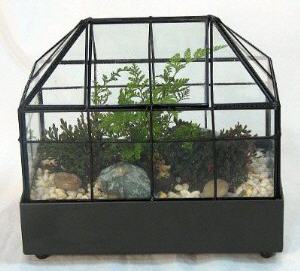
Terrariums come in all shapes and sizes today. Pictured at left is the classic Wardian case style of terrarium. A Wardian case is a glass-enclosed house. They’ve been designed at times to imitate famous architecture from around the world. Sometimes they sit on a tabletop and sometimes they are freestanding. Photo: Amazon.com.Choosing a Terrarium Container
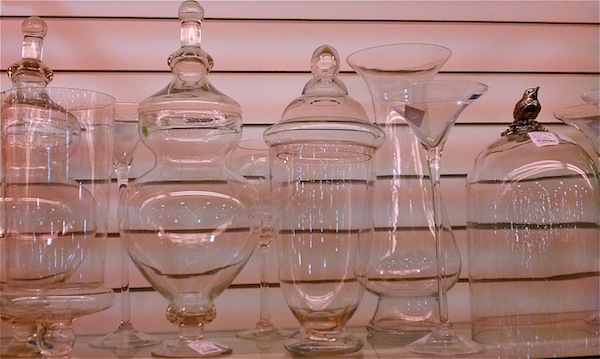
These containers were at my local HomeGoods store in Torrance, California.There are many different containers you can adapt for your modern terrarium. You can use anything as long as it has clear glass that allows sunlight in and for you to be able to see the plants inside. Think about the size and type of plants you want to display and then choose a case that will work best. Or…if you have a jar or vase that would be large enough to fit a small plant, it’s time to go shopping at your local nursery. Here is a break down of some options I found while shopping at my local vase supply, HomeGoods store and in my own cupboards!
- A cloche or closed jar will provide the most humidity, so if you choose this container, then choose the humidity-loving plants to go inside.
- A lantern can be adapted as a fun terrarium and can be used for less-humid loving plants if the top is not enclosed.
- A classic closed Wardian case can be used for plants that are potted directly into the bottom of the case or it can be used as a mini greenhouse with plants still in their pots. Keeping plants in mini pots allows you to change the plants with the seasons.
- Vases, compotes and tureens have wide open mouths and can be used for more arid-loving plants like succulents.
Humidity-Loving Plants Work Well in Terrariums
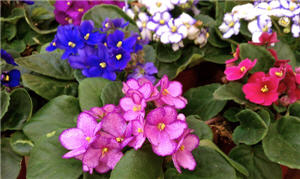
Since most terrariums help build up humidty inside the container, it’s best to use plants that like humidity. Think about tropical plants and other plants that like rain like ferns and mosses.African violets pictured here at left, work great in terrariums.
Dos and Don’ts for Creating Terrariums
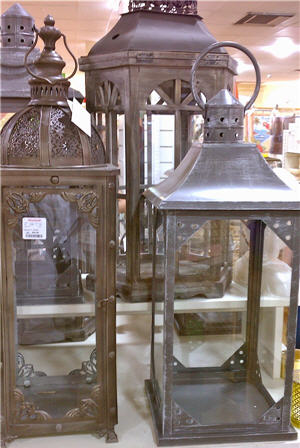
Lanterns can make a fun choice for creating a terrarium. Note: If you use something like the tall lanterns in the photo at left I found at my local HomeGoods store, be sure to water the garden inside a little more often than if you use a completely closed container.
- Do choose plants that like humidity and shade — Options include African violets, ferns, mosses, orchids, begonias, and pileas.
- Do choose small plants or break up a larger plant into smaller plants.
- Do keep soil moist, but not wet. Water just enough to keep the soil moist. The size of the terrarium and number of plants will dictate how much water you need to use. Also, whether or not the container is closed will also be a factor in how often and how much you water.
- Do use activated charcoal (found in aquarium stores or nursery centers) and pebbles in the base of a soil-filled terrarium. This will help keep the soil fresh and cut down on fungi inside a terrarium. See steps below for how to apply the charcoal to your terrarium.
- Do use gloves when working with the soil and some types of moss. Sphagnum moss can give you a fungal infection called Sporotrichum schenkii that affects the skin, so use gloves when working with it. Also, try to make sure you purchase moss that is grown in the United States only. A good bet is moss grown in Oregon. NOTE: It’s also a good idea to use gloves when working with the activated charcoal.
- Don’t use plants that like an arid climate if you are using a closed glass container. Plants to avoid include cactus, succulents, air plants (tillandsias), herbs and alpines.
- Don’t overwater! Closed terrariums are meant to be used in order to minimize the need for water since the closed atmosphere creates its own humidity. Even a container that is open at the top will have some humidity inside.
How to Create a Terrarium in a Tall Closed Jar
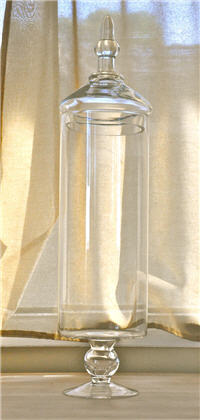
Step 1: Start with a clean container and choose plants that wick up moisture (like tropical plants). If you are not sure what to purchase, just ask for help at your local garden center. I chose a tall and thin apothecary jar since its small profile will fit nicely into our small home. With 15-month-old twins in the house, I don’t have much counter space these days! For the plants, I chose a tall and skinny mini palm and a small low growing polka dot plant that I could break up into smaller plants to surround the palm.
Step 2: Gather all the supplies you’ll need for this project. Container, gloves, plants, soil, charcoal, dry paint brush (to clean inside of vase after you’ve added the plants) and a small trowel or weeder tool.
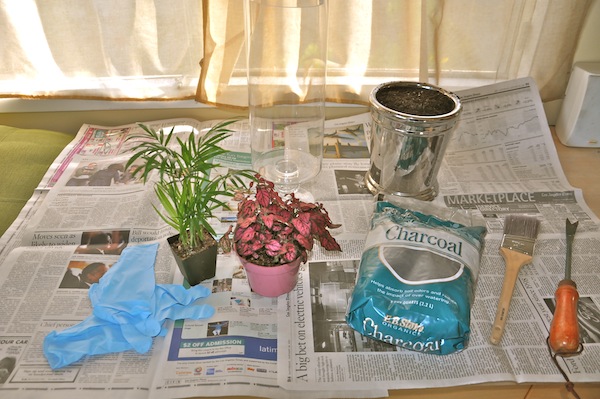
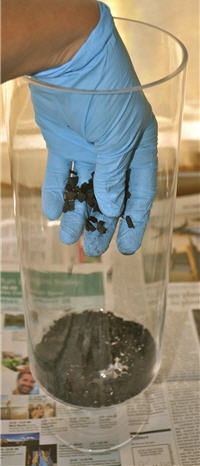 Step 3: Put on gloves. Add activated charcoal to the bottom of the container to cover. I was able to purchase charcoal at my local garden center. I asked a worker for help finding “activated charcoal” and his reply was, “Do you mean charcoal you put in the bottom of a terrarium?” I said, “Yes.” He said, “Well, I’ve never heard it called activated charcoal, but there it is.” Turns out, I was standing right in front of it!
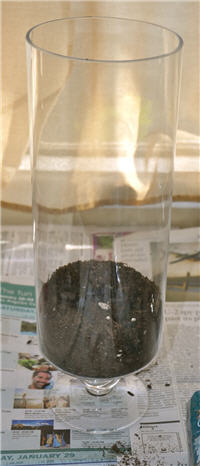 Step 4: Mix well-drained soil and with a bit of charcoal and put that on top of the layer of charcoal. Remove the plants from their nursery containers and carefully place them into the soil in the container. In this example, I placed the mini palm tree first and then broke up the Polka Dot Plant (Hypoestes phyllostachya) into smaller plants and placed them to surround the palm. I then added soil around all the plants. One tip from the book The New Terrarium: Creating Beautiful Displays for Plants and Nature is to tamp down the soil using a “cork-tipped barbecue skewer.” I did not need it, but I think that is a great idea!
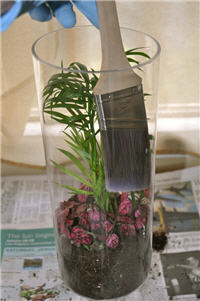 Step 5: Clean the sides of the container. I used a dry paint brush to carefully brush off any soil that ended up on the leaves of my plants and to clean the sides of the vase.
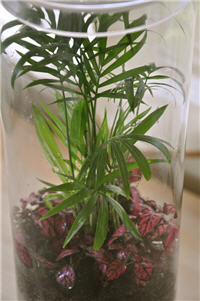 Step 6: Add a little bit of water to the container.
Step 7: Put the top on and display in your home! Choose a spot that has bright light, but not direct sunlight.

Want to learn more about building all kinds of terrariums? Keep reading below to learn about air plants and then check out the three terrarium how-to books we review in this month’s newsletter, too! They are all excellent resources for those of you who want to make your own lovely indoor mini gardens at home. Why not grab a few friends and have a “Terrarium Party.” That way, you can split up the larger plants you buy and nothing will go to waste. Plus, the charcoal bag I bought goes a long way, so this is another way to share the cost. Grab some wine and appetizers and have fun with your little gardens.
All About Air Plants or Tillandsias and Yes, They Do Flower!
by Kit Wertz

A glass globe vase makes a great home for a couple of tillandsias nestled in moss and it really brightens up my office.
Flower Duet’s History with Air Plants
When I mentioned to Casey that I wanted to do an article about air plants and their rising popularity, she had a funny story to tell me about her own relationship with the cute little plants. Casey worked on cruise ships as a ship’s officer for over 12 years and as a junior purser on board one of her ships that cruised through The Bahamas and Caribbean, she sold these little air plants that were glued to refrigerator magnets. She said that they sold like crazy and the ship made a lot of money from the sales! Well, it’s funny how some things never go out of style.
What are Air Plants?
Air plants are actually called Tillandsias and these are part of the Bromeliaceae family more commonly referred to as Bromeliads. They are referred to as air plants, or epiphytes because they don’t require to be in soil to grow. Most tillandsias come from Latin America and grow in arid environments. An example of Tillandsia that grows profusely in the American South is Spanish Moss, Tillandsia usneoides (oos-nay-oh-EE-dess).
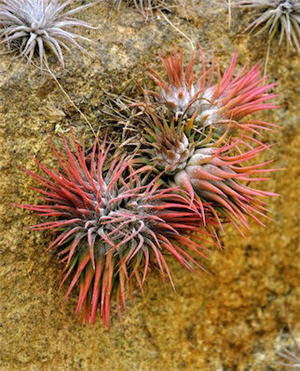
Tillandsias have exotic blooms and are very hardy. Most are xerophytic which means they like arid climates. This attribute makes them an excellent choice for the low-maintenance gardener! These plants reproduce by sending out little babies called “pups” or offsets. There can be many offsets on a single parent plant and then they can be divided into individual plants or just left to grow in large clusters.
Where to Buy Tillandsias
We are so fortunate to live very close to a grower of these wonderful plants. Located in the heart of Torrance, California, Rainforest Flora, Inc. has been propagating and growing tillandsias since 1976. The owner, Paul T. Isley, III, is happy to share lots of information on these wonderful and unique plants. You can order online at www.RainforestFlora.com or purchase directly from the store in Torrance. Rainforest Flora, unlike any other Tillandsia supplier who all rely on imported/collected plants, grows all of its plants in their entirety at one of their three California facilities. This ensures a sustainable product that is also a hardier plant.
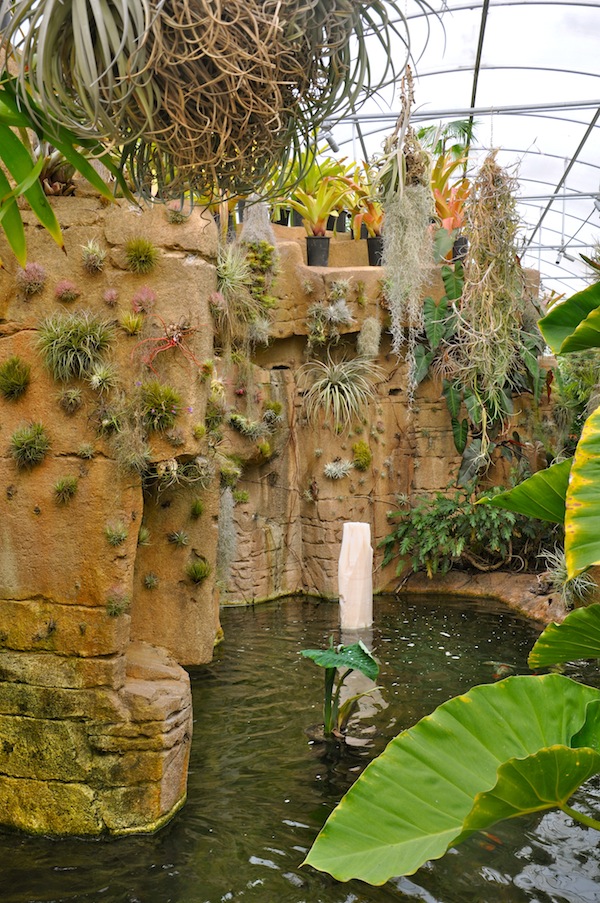
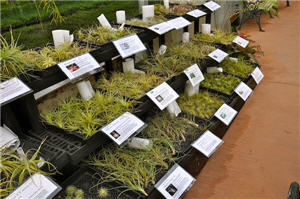
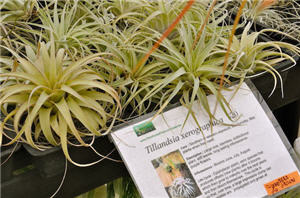
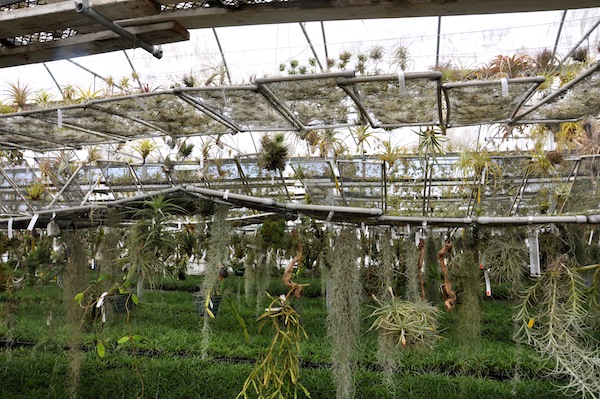
As you can see from the photos below, it’s worth the trip to the nursery to see all the plants on display. There is a large indoor botanical garden with koi pond that is free and open to the public. All throughout the garden are hundreds of tillandsias and bromeliads for sale. Many of these are grown from seed and are many decades old!
Getting Tillandsias to Flower
When I went there to do research for this article, I could not help but purchase five different kinds of tillandsias. There were so many to choose from and at first glance, they look very similar. But, the more you look at each one, you start to notice subtle differences. None of the plants I chose is currently flowering, but I read in Mr. Isley’s booklet Genus Tillandsia: The World’s Most Unusual Air Plants, that I can try to force a flower by putting the plant into a plastic bag with a ripe piece of apple for a couple of days. The ethylene gas from the apple should force a bloom within 16 weeks if I’m lucky. It’s funny that the same gas that causes cut flowers to wilt is just the trick to get a flower to bloom on a tillandsia! I can’t wait to share that with my floral students since I am always lecturing on why you shouldn’t mix apples with fresh floral designs if you want the flowers to last a long time.
How to Display and Care For Tillandsias
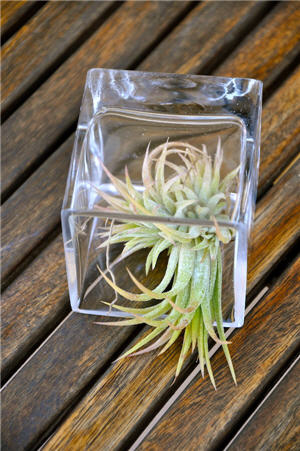
Since these plants don’t require soil, there are innumerable options and ways to display them! Tillandsias will be happy indoors or outdoors. Keep them in bright indirect light, especially indoors. Shown here are tillandsias in a vase (without water), hanging from aluminum florist’s wire (we talk about this wire in our April 2010 newsletter), in a glass cube vase, and inside a hanging teardrop vase that is made especially for air plants!
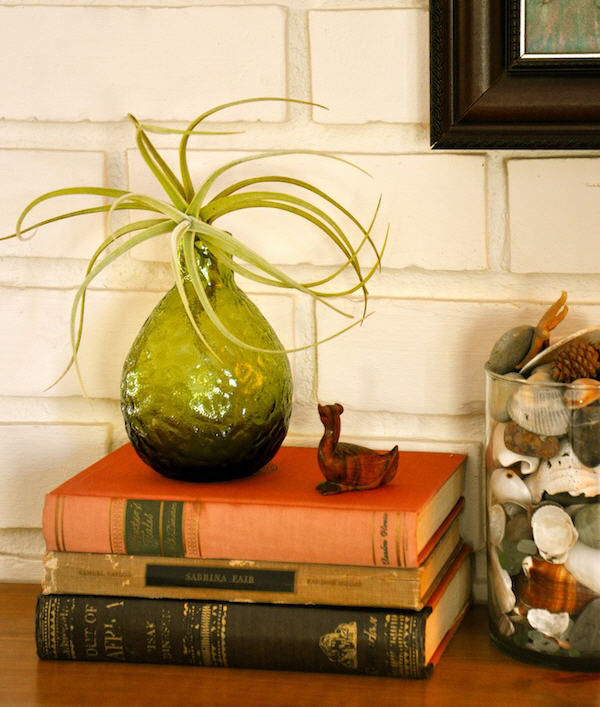
The tillandsia above looks like it’s in a vase, but the vase does not have any water in it. It’s an example of a truly low-maintenance floral design!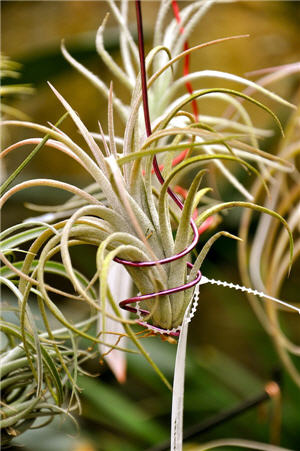
According to Rainforest Flora, the most common mistreatment is under watering them: “Misting the plants CAN be sufficient but it can also be OVER-sufficient or UNDER sufficient.”
The best way to water tillandsias indoors is to submerge them for a twelve hour period in “good” water such as rain water or bottled drinking water every 10–14 days. When the plants are under water for this length of time they have enough time to completely rehydrate. Be sure to add a tiny amount of fertilzer to the water. Mr. Isley mentioned to me, “I usually tell people to run the plants under the faucet two or three times a week and then submerge them overnight in good water if they notice the leaf edges starting to curl up more than normal.”
For more information on how to do this, watch a video on from Rainforest Flora, Inc. on how to care for Tillandsias.
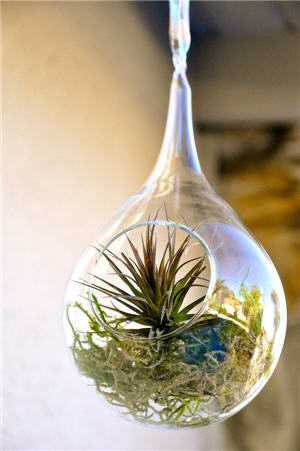
The hanging teardrop glass vase shown above can be purchased from vendors online. See our tools section in this newsletter to find resources.
FREE Video: How-To Combine Succulents with Fresh Flowers in a Floral Design
Flower Duet Adds More Videos to its YouTube Channel
We continue to add more free videos to our YouTube channel. Casey appeared on behalf of Flower Duet for the 2010/2011 and 2011/2012 seasons of Creative Living, which airs on PBS stations across the country. We are able to air these segments with the permission of Creative Living via our channel on YouTube!
This month’s video is called How-To Combine Succulents with Fresh Flowers in a Floral Design. In less than ten minutes, you can learn how which flowers pair best with succulents and how to get those plants into a floral design!
Subscribe to our YouTube channel: fashioningflowers so you’ll know when we’ve uploaded a new show!
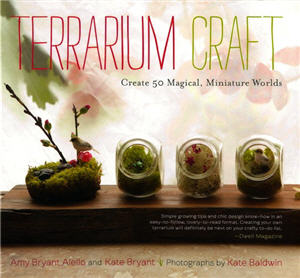
Published just last year, Terrarium Craft shows you 50 different recipes for creating fun and whimsical terrarium displays for your home or workplace. This book leans a lot more toward the succulent display trend and we love that! Each design is detailed down to the exact plants and additions like sea shells, sand, pebbles and mosses used so it’s really easy for you to recreate yourself. But, if you are looking for more traditional terrarium displays with tropical plants, we recommed the book we review below called The New Terrarium.
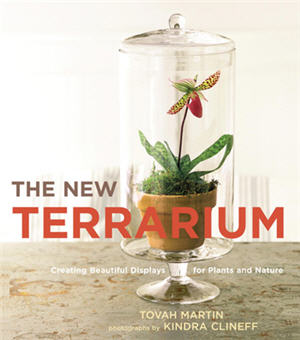
Author Tovah Martin of The New Terrarium, takes you step-by-step through the process of making all types of terrariums in different containers. This book is richly detailed and gives you all the knowledge you need to create your own perfect terrarium. With photos by Kindra Clineff, this book is a delight to pick up over and over again. Flower Duet highly recommends this book for your craft library.
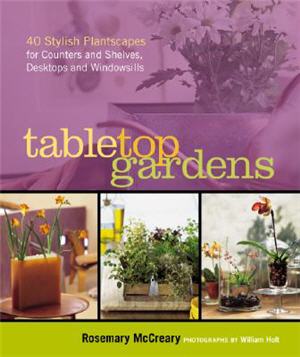
Tabletop Gardens: 40 Stylish Plantscapes for Counters and Shelves, Desktops and Windowsills by Rosemary McCreary
Tabletop Gardens: 40 Stylish Plantscapes for Counters and Shelves, Desktops and Windowsills, may have been published more than a few years ago, but it was a book ahead of its time. In it, author Rosemary McCreary showcases all types of plants from orchids to daisies to succulents to daffodils in a variety of tabletop gardens. It’s full of practical advice for beginner gardeners and offers great design ideas for the more experienced plant lover.
Floral Design Tool: Air Plant and Terrarium Display Vases
We found a lot of places to purchase terrarium vases, containers and air plant glass globes online. Some vendors carry both kinds of containers.
I found many great apothecary jars, bell jars and lanterns at my local HomeGoods store. That is where I found the tall jar I used for my step-by-step story and it cost less than $15!
If you don’t live near a HomeGoods store, there are more online options. Here are a few:
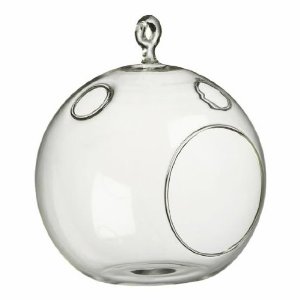
Globes can be found on Amazon.com.Air Plant Hanging Glass Globe from Amazon.com
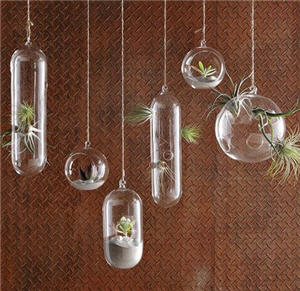 You can purchase a variety of air plant vases from WestElm.com. Photo: WestElm.com.
WindowBox.com carries glass air plant globes and Wardian terrarium cases. Photo: WindowBox.com.

UncommonGoods.com carries a large selection of air plant globes. Photo:Uncommongoods.com.
As Amazon Associates, we receive commissions from products purchased via links in our blog and newsletter articles. See our florist tool recommendations and floral book recommendations on our creator page.
Read more Flower Duet News & Newsletters from past years:
Each month, we cover a current event in the floral trade, florals from real weddings, our latest flower adventures and endeavors, design tips, current floral trends, floral design classes and workshops, book recommendations and floral tool tips.
Since 2010, we’ve created a hot list of what’s on for floral design in and beyond Southern California. As guest speakers inside and outside of California, we know what clients need in the wedding and event industry. We are your trusted resource for floral design tips and techniques for all levels of the flower enthusiast.
We are Kit Wertz and Casey Schwartz, the sister design team of Flower Duet. We are committed to educating our students and fans since we started our floral design business in 1999.
We don’t share our email list with anyone! So, you can rest assured, your email is safe with us.